Eigg Mountain Wind Project Environmental Assessment (EA)
Response from the Moose Conservation Association of Nova Scotia
Submitted to Environmental Assessment- Project Comments
After a review of the Environmental Assessment (EA) document for the Eigg Mountain Project, the Moose Conservation Association of Nova Scotia (MCANS), is writing to express the extremely serious, irreversible, negative effects of the project on the resident moose population in the area should it be allowed to proceed. This includes its effects on the government of Nova Scotia’s legislated requirement to protect and grow that population under the 2021- Recovery Plan for the Moose in Mainland Nova Scotia. That submission along with all EA’s submitted for any area where there are known moose populations should be judged not only on their immediate effects on that current population but their effects on the potentially increased population envisioned in the Recovery Plan and how it may prevent that recovery and expansion. It is a common sense approach that increased populations will result in elevated use of areas that are currently in use as well as movements into adjacent areas.
MCANS began engaging with the project's CBCL EA Practice Lead for Environmental Services, Nicole MacDonald, undertaking the EA on behalf of the proponent, and the project’s proponent Renewable Energy Services (RES) Engagement Manager, Michael Murphy, at the open house information sessions in Maryvale on April 29/2025 and Arisag on April 30/2025. This was followed by numerous phone conversations, in person meetings and emails up to the release of EA on February 18/2026.
On numerous occasions MCANS expressed our concerns about the project's proposed location in the center of an extremely sensitive area with extensive wetlands and stands of old growth forest, both being vital to the survival of resident moose in the area.
In section 3.3.2 Special Interest Group Engagement on page 44 of the EA the following quote reports on some of those communications, ”The Proponent, along with CBCL, met with MCANS on November 18, 2025 and exchanged email information during the course of the engagement period. MCANS raised concerns with respect to the loss of Mainland Moose habitat as a result of the Project, namely in proximity to a wetland located in the center of the Project Area. MCANS also requested to be informed of when the EA registration document would be available for review. The Proponent and CBCL provided environmental information on the site as well as outlined the key commitments to siting, such as avoiding watercourses and wetlands to the extent possible, minimizing the AOD for roads and turbine positions, and committing to avoid old growth forests. One turbine of concern for MCANS was an alternate turbine, i.e., a turbine that is not planned to be part of the 22-turbine Project unless major circumstances would remove one of the 22 main turbines.”
The EA comments suggest that a representative of CBCL was present at the November 18/2025 meeting which is factually incorrect. That meeting included only two MCANS representatives Edward Dewtie and Al Muir and a single RES representative, its Engagement Manager, Mike Murphy. Further to this it is suggested in the quote from the EA on page 44 that there was “One turbine of concern” to MCANS and it was an alternative. This is also factually incorrect as MCANS contention, at the meeting and in numerous other communications, was that all the turbines and electrical and building structures in proximity to the wetlands and old growth forest stands were serious threats to the resident moose population. This includes a large number of the turbines making up the project. Even in the case of the one turbine mentioned in the quote there is a caveat that that turbine might still be erected. That caveat regarding the “one turbine” is repeated in a number of other places in the EA.
Attached is a diagram from RES reported in the EA, Figure 2.2 titled Turbine Layout and Turbine Siting Constraints, that demonstrates the wetlands and old growth forest at the center of the project, that the multiple turbines encircle. They are recorded in dark blue and red in the diagram. In addition to that in the same diagram the electrical substation shown in purple sits directly between the wetland and old growth forest stand. The importance of wetlands and old growth forest to the health of the resident moose population is referred to repeatedly in the EA.
The EA in Table 10.1 Camera Trap Deployment and Retrieval Dates Total Survey Days and Habitat, reports that 12 different trail cameras were deployed for different durations, with one reported as being set for 205 days. In Table 10.4 Summary of Terrestrial Wildlife Observations Via Camera Traps it is reported that there were a total of 7 moose observations across 12 different cameras. MCANS set 1 trail camera in May of 2025 and recorded 9 observations from that single camera in the approximately 2 month period from May 19th to July 11th of 2025. MCANS lead expert on the area Edward Dewtie with over 50 years of experience with the area identified important travel routes and moose usage areas for best camera setting options. The result is a testimony to the experience levels of the membership of MCANS in relation to moose, their movement patterns, and their utilization of varying habitat features. MCANS camera, located in the center of the proposed project, speaks to the use of the wetland area and the importance of maintaining it and its surroundings in their current state. Both those wetlands and their surroundings where the project is planned. In fact parts of the Eigg Mountain- James River Wilderness area are interwoven with the project area.
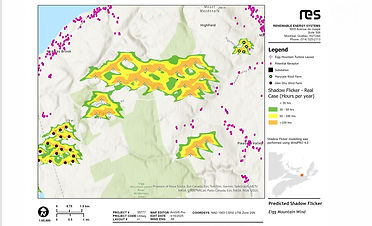
The EA’s ambivalent contention is that the area can support the turbine project despite the towers being in the immediate proximity of the wetlands and old growth stands. That ambivalence is spelled out in numerous parts of the report. In Section 10.3.1 of the EA on page 151 it states, “The rise in Project-related vehicle traffic poses a risk of mortality and injury due to collisions. Additionally, sensory disturbance from light and noise during construction, operation and maintenance, and decommissioning could impact wildlife behaviour.” Attached to the EA submission and this communication are the Predicted Sound Level, Sound Pressure Levels and Predicted Shadow Flicker diagrams of the project, with the wetlands and old growth stands in the center of the project turbines and the electrical substation and operation & maintenance building in the same vicinity . The levels of noise and light in the diagrams are considerably higher than human habitation tolerance levels and even more concerning for moose that are more sensitive to and intolerant of this type of activity. The proponent has been careful to ensure the project is a significant distance from human habitation to avoid these noise and light issues but dismissive of their effects on the resident moose population.
In Section 10 - Terrestrial Wildlife, on page 137 of the EA it states, “The Project has the potential to affect terrestrial wildlife through direct pathways, such as increased mortality risk from vehicle or equipment movement during construction, operation and maintenance, and decommissioning phases, and through indirect pathways, including habitat loss, fragmentation, and modification. Wildlife may also exhibit behavioural changes, either short- or long-term through avoidance of habitats subject to disturbance or noise, depending on species-specific tolerance to disturbance.” The problem is expanded on in Section 10.3.1.1 Habitat Loss and Fragmentation, on page 153 of the EA is states, “While direct research on the effects of wind-farm clearing and activity on Moose is limited, studies on other large ungulates and on Moose in forestry-cleared areas provide insight into how Project-related habitat loss and fragmentation could influence the local Mainland Moose population. Habitat loss, conversion, degradation, and fragmentation from wind projects are known to present a threat to large terrestrial mammals in Europe (Tolvanen et al., 2023 and Schöll & Nopp-Mayr, 2021). For example, one literature review study found that 67 percent of papers reviewed on large terrestrial mammals reported a displacement”. Given the location of important wetlands and old growth forest in the center of the project these effects should be expected to be profound. The proposed development is in an area where they cannot be displaced with any degree of certainty that they would survive that displacement . As page 5 of the EA on the project points out,” As is characteristic of upland ecodistricts, wetlands and lakes are relatively small and few;..”. In Section 10.3.1.3 Disruption of Life History, on page 157 states,” During the Project construction period, disturbance levels are expected to be comparable to active forestry operations, but extended over a longer duration (excluding short-term, isolated activities like blasting). Wildlife may exhibit behavioural changes as a result of the Project and seek out alternate habitats outside of the LAA due to sensory disturbance and stress. In the operation and maintenance phase, sporadic increases in lighting, traffic, and human presence may occur, potentially prompting wildlife to avoid or abandon suitable habitats over the longer term. The greatest difference in the disturbance regime in the LAA as a result of the Project may arise from the noise (and possibly vibration) generated by the operating turbines.” and, ”The Mainland Moose Recovery Plan recognizes stress from renewable energy infrastructure, specifically citing artificial lighting sources and the flicker effect as a potential threat to the Mainland Moose (NSDNR, 2021)”. On page 64 of the EA Table 5.2 points out that there is a potential change in the acoustical environment through all three stages of the project, construction, operation and maintenance, and decommissioning with a change in ambient light over a similar time frame.
In Section 15.3.1.4 Terrestrial Wildlife (Mainland Moose) page 259 the EA states, “ Areas of particularly high-quality habitat for moose were avoided wherever possible, such as avoiding mature forest and wetlands. Two proposed turbine locations with observed moose activity and likely in a Moose travel corridor as indicated through survey efforts and engagement with members of the public, A3 and A24 (Figure 1.1, Eigg Mountain Wind Project EA Registration Document 259 Appendix A), are considered alternative turbine locations as a contingency measure, in case one of the intended turbine locations is deemed to be unsuitable for environmental or structural reasons.” Obviously surrounding these wetland and mature forest areas with wind turbines could hardly be called avoidance even without the two ”contingency” turbines that may or may not be removed from the project. As previously stated MCANS informed RES and CBCL on a number of occasions that there were a significantly larger number of turbines that met the conditions of the two ( that may or may not be erected) if the project proceeds.
Given the sensitive nature of the project's turbine placement area and its associated infrastructure and their location in the heart of the heaviest moose utilized localities in the general area, the proposed Eigg Mountain project is in the worst possible place. It would be difficult, if not impossible, to find an area in the province more suited for protected status. As that localized area is interwoven with existing sections of the Eigg Mountain- James River Wilderness area, it is a prime candidate for addition to that protected area, not an area suitable for this development.
In Section 10.3.1.1 Habitat Loss and Fragmentation, on page 153 of the EA it states, “The Project is located in the Pictou/Antigonish/Guysborough Mainland Moose subgroup concentration area, and the area is identified as Core Habitat by the Mainland Moose Recovery Plan (NSDNR, 2021). The Recovery Plan recognizes renewable energy projects and road construction as activities likely to cause adverse effects, including the destruction of important moose habitat, through habitat loss, conversion, degradation, and fragmentation.” In Table 15.1 - Screening of Potential Cumulative Environmental Effect, on pages 255-257 of the EA under Degree of Cumulative Effects of all Projects, Undertakings and Activities in a listing of the potential negative effects low, moderate and high Moose are the only one listed as high out of twenty six separate rankings. Along with the existing Glen Dhu wind project approximately one kilometer from the proposed Eigg Mountain project there are 3 more across the Trans Canada highway southwest of Eigg Mountain. One the Weavers Mountain Project in the construction phase, one the Sugar Maple project in the public consultation phase and the third the Yellow Birch in the proposed stage. Adding to the problem, but not discussed in the Eigg Mountain EA, is the failure in the recent twinning of the Trans Canada Highway in the area to add road crossing aids for wildlife, making habitat connectivity in the region an even more serious concern.
While these projects are cumulatively recognized as highly rated threats in the EA, the self standing Eigg Mountain project is of particular importance due to its location in an extremely sensitive area surrounding combined wetlands and old growth forest stands and interwoven with areas already deemed necessary to protect in their inclusion in the Eigg Mountain- James River Wilderness area. It cannot be overstated, or repeated often enough, how important it is that the proposed Eigg Mountain turbine project area be considered for addition to that protected area. The erection of those proposed turbines on Eigg Mountain, will in effect, signal the abandonment of the legislated 2021 Recovery Plan for the Moose in Mainland Nova Scotia.